


![[Shopify] Blog Post](https://www.intentwise.com/blog/wp-content/uploads/elementor/thumbs/Shopify-Blog-Post-scaled-rhxym0oh21j2khmofggyl9r8onhapb2dhh94e1pqv4.jpg "[Shopify] Blog Post")
These days, you can’t get away with letting your Shopify data live in a silo.
For a long time, Amazon and Shopify felt like totally walled gardens.
Yes, you’ve always known intuitively that there’s going to be some overlap between these sets of customers.
It’s inevitable: some people who see your ads on Amazon will buy from your DTC site, and some people who see Instagram ads that link back to your Shopify site will buy from Amazon instead.
These connections, however, have been nearly impossible to track—until recently.
Now, Amazon and Shopify are becoming more explicitly interconnected.
Amazon is surfacing external links to DTC stores in Amazon.com search results.
Meanwhile, companies like Adidas are beginning to add “Buy with Prime” as a checkout option on their Shopify sites.
Meanwhile, AMC is letting businesses bridge deeper links between their Amazon and Shopify customers.
This means you can finally think more strategically about how your Shopify data fits into a larger portrait of your performance.
Say you run a TV ad campaign, for instance. To really get a picture of how effective that ad campaign was, you want to measure conversions across all channels—on Amazon and Shopify (and others).
Having your data interlinked, and in the same hub, makes that much easier.
How can I connect my Shopify data to other channels?
Shopify already allows you to create some important cross-channel connections about marketing and conversions.
By embedding pixels on your website, you can link social ads on TikTok or Meta back to your Shopify store visits or purchases.
Amazon has a pixel for DSP ads—but you can track a broader set of connections between your DTC and Amazon touchpoints by uploading your first-party data to Amazon Marketing Cloud.
To do this, start by organizing a list of names, emails, and phone numbers of all of your Shopify customers.
When you upload a hashed version of that list to AMC, Amazon will match your shoppers, in an anonymized, privacy-safe way, back to its own shoppers.
Are the same people who buy from you on Shopify also buying from your Amazon store? And if so, are there notable differences in what they buy on one platform or the other?
Now you can find out.
If you upload metadata alongside your customer lists, which Intentwise can help you do, you’ll also be able to segment shoppers more granularly. This approach lets you cthe overlap between high-value and low-value shoppers, for instance.
Why upload your DTC data to AMC? On one hand, with these connections, you can create powerful new AMC audiences. To avoid cannibalization, you can exclude all your Shopify customers from your Amazon DSP ads, for instance.
But you can also refine and advance your understanding of your pre-existing metrics.
Connecting your Shopify data to AMC will also give you a much fuller portrait of your paths to conversion, your LTV, and your New-To-Brand metrics.
Maybe a set of shoppers who Amazon reports as New-To-Brand aren’t actually that new, since they’ve been buying from your Shopify store.
Or maybe some people who saw your Amazon DSP ad didn’t get credit for converting, because they actually converted on Shopify instead of on Amazon.
How do I intermingle my Amazon and Shopify data more broadly?
What if you want to see high-level correlations between your DTC performance and your Amazon performance?
Maybe see if an ad campaign lifted sales on both Shopify and Amazon?
It’s far easier to track top-line correlations if you’ve pipelined your Shopify data into the same software platform where your Amazon data already lives.
That’s the promise of Intentwise right now. We’ve just added Shopify as a data source in Intentwise Analytics Cloud, which means Intentwise now pipelines and displays Shopify data on:
- Unique visitors
- Average order value
- Total discounts applied
- Bounce rate
- Adds to cart vs. completed checkouts: How many people are dropping off?
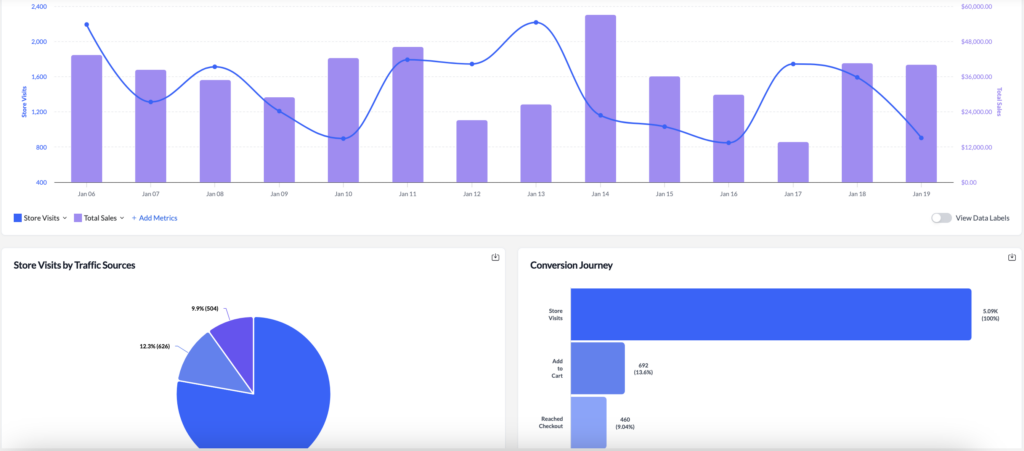
Our platform will also track cross-cutting metrics like:
Store visits by traffic source. Our dashboard automatically compares the different referrers to your Shopify store: direct vs. email vs. organic visits to your Shopify store.
We’ll also pipeline data that breaks down visitors based on traffic source, comparing clicks from TikTok, Instagram, Meta, and any other URL.
DTC conversion journey. Once a shopper lands on your site, how well do they convert?
We’ll break down shoppers based on their last touchpoint in the conversion journey: you can compare the total number of store visits, to total number of adds to carts, to total number of completed checkouts.
With this data, you’ll get a sense of the raw conversion rate, so you can figure out what share of your visitors actually complete their checkout.
Miscellaneous metrics. Our platform also displays Shopify data like purchases by geography, unused gift card balances, and taxes collected.
Why intermingle your Shopify data?
With your Shopify data in the same place as your Amazon, Walmart, Target, and TikTok data—as it can be with Intentwise—it’ll be easier than ever to make cross-channel correlations.
With one toggle, see whether a performance dip is isolated to one platform, or whether a new ad campaign seems to be increasing product page visits across all of your sales channels.
If you’d like to see how it works, book a demo of Intentwise Analytics Cloud today.
How do you pipeline Amazon Ads data?
Intentwise builds the most reliable data pipelines for Amazon. The Intentwise software connects your Amazon advertising, retail, and Share of Voice data into your reporting system, with 24/7 monitoring to ensure nothing breaks.
Intentwise also pipelines data from Amazon Marketing Cloud for deeper analytics.