
Improve Amazon DSP performance with Claude



One of the most difficult parts of running Amazon DSP campaigns is measuring your return on ad spend.
DSP campaigns require a lot of upfront spend—and Amazon’s default attribution metrics, which tie DSP ads back to KPIs like branded search metrics, don’t often tell the full story of how they perform.
The attribution and troubleshooting gap for Amazon DSP is becoming all the more important as these ads appear on massive platforms like Netflix, Disney, and Roku.
They’re a critical marketing tool you need to get right.
With Amazon Marketing Cloud, of course, it has been possible for a few years to analyze shoppers across the funnel, and see the real impact of DSP campaigns.
But unlocking those insights still involves poring over query results.
There’s now an easier way. With your data connected to AI, you can analyze the success of your DSP ads—and improve their efficiency—far faster.
Level up your Amazon DSP troubleshooting with Claude
When you run your AI agent across your full suite of Amazon data, you’ll be able to map out shopper behavior across the funnel far more easily.
Our AI Gateway MCP brings all of your Amazon data into your AI agent, including DSP ad data and AMC query outputs, meaning you can ask questions across retail, DSP, Share of Voice, SQP, and AMC.
With AI helping to analyze your DSP ads, you’ll be able to:
Avoid over-exposures. If a shopper is in your target demo, they might see several ads about the same product over the course of days or weeks.
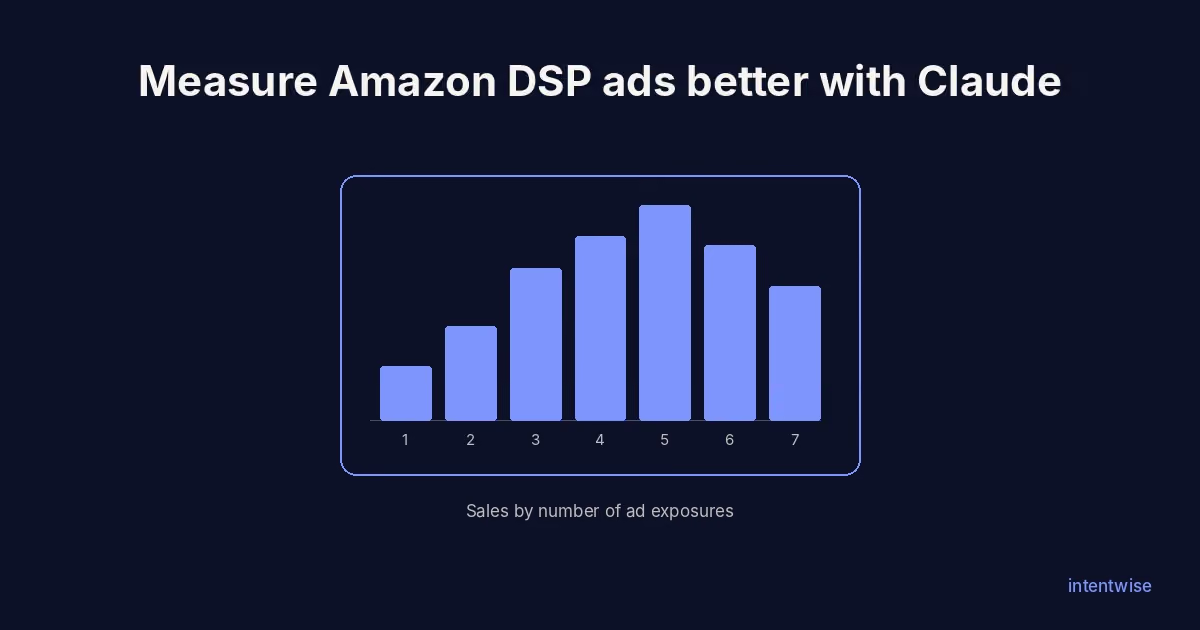
The first few ads do usually help to increase conversion rate—but there comes a point when you’re over-exposing shoppers who are never going to convert. And that means throwing ad spend down the drain.
To solve, ask your AI agent to map out how conversion rates increase, based on the lifetime number of DSP ad exposures.
For every ASIN, what is the inflection point where you’re exposing shoppers too many times?
Exposure frequencies vary from product to product. The pricier the products, the more touchpoints a shopper probably needs before they purchase.
Your AI agent can easily pinpoint the ideal number of exposures to convert a sale.
Then, set up those frequency caps in your Amazon ads account to ensure you don’t waste spend.
Track DSP overlap with Sponsored Ads. Only a small number of shoppers will convert immediately after seeing your upper-funnel DSP ads. That’s why it’s so critical to understand how DSP ads fit into the full path to conversion for your buyers.
Where in the funnel are your DSP ads most effective? Which ads, when paired with one or multiple Sponsored Ads touchpoints, convert the best?
When you bring your path to conversion data into your AI agent, you can ask Claude or Copilot any question you want about which steps shoppers take before buying from you.
Quickly compare DSP performance across audiences. AI agents are really good at audience segmentation.
Ask your AI agent how your performance is different for broad swaths of audiences. How do your DSP ads perform differently for New-To-Brand vs. repeat shoppers, for instance?
Or compare ad-exposed shoppers to organic shoppers. After all, when thinking about the success of your DSP ads, you don’t just want to stop at the initial sale.
Rather, consider the long-term value of shoppers who were DSP-exposed. Run a comparison of organic shoppers vs. ad-exposed shoppers by LTV, repeat purchase rate, and more.
You can see how much value those DSP-exposed shoppers are actually adding relative to the organic baseline.
Consider similar audience comparisons based on average order value.
Often, your AI agent can surface actionable insights on this front.