
How AI agents are rewriting your marketplace data stack



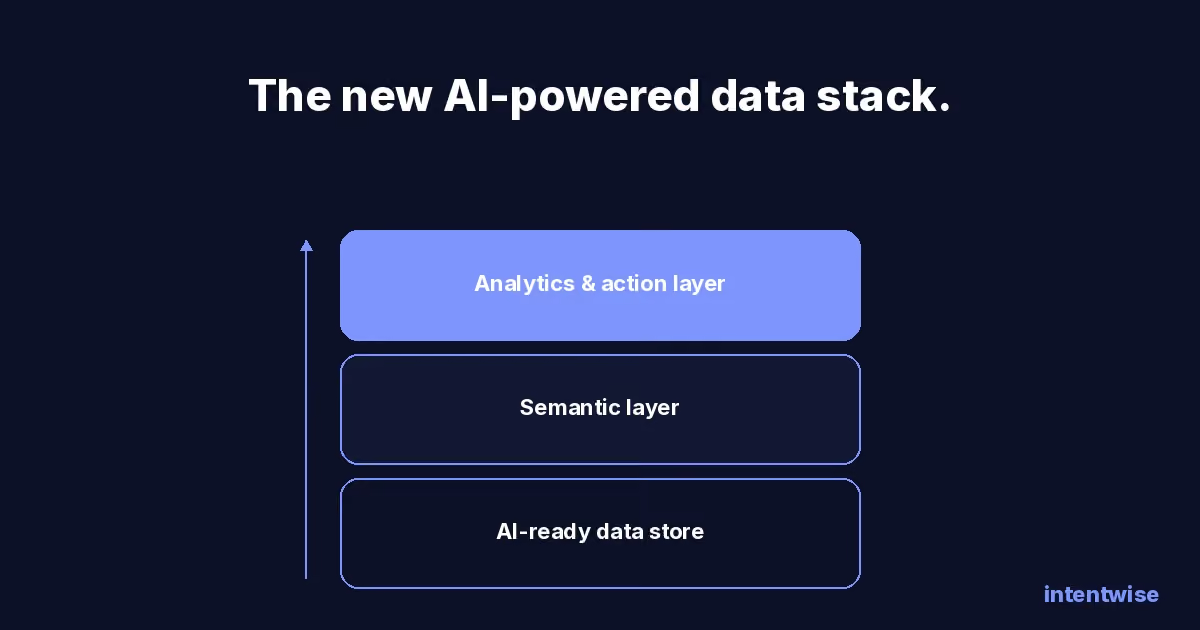
Think about your data stack. It’s the set of software services that you depend on to collect data from all of your sales channels, synthesize it into insights, and then take action.
In the old-school version of the marketplace data stack, you as a brand or an agency needed to plan out all of your use cases in advance.
Dashboards were clunky and cumbersome to build, which meant that you needed to figure out all of the most important data points you wanted to see every time you log in (CTR? Share of Voice? Inventory levels?).
Then you had your team, or software partner, build those dashboards for you from scratch.
The problem with this system is that, in the course of a day, you might have questions beyond the scope of your dashboards.
What happens if your dashboard didn’t answer your question? You’d either need to submit a request for a new dashboard, which would again take days to build, or you’d need to leverage SQL to find the answer yourself.
The result was more dashboards than anyone really needed: dashboards designed to answer one specific question, and then abandoned after.
How are MCPs changing the marketplace data stack?
The rise of AI agents and MCPs has fundamentally reshaped the marketplace data stack.
Now, the basis of your stack is an AI-ready data foundation that can send trusted data wherever you already work—whether in a business intelligence platform or in your AI agent.
With this new data stack, you don’t need to rely on a bunch of pre-built dashboards.
Instead, you can ask deep questions of your AI agent using natural language, and build workflows that send alerts directly into Slack or your email.
The best part: auxiliary questions are no longer difficult to answer.
Let’s say in the middle of your work day you have a stray analytics question—“how has the NTB rate on my top 5 ASINs changed over the last year?,” for instance.
Previously, you would have to spend several days either building a new dashboard that maps NTB rates over time, or going back and forth with your analytics team to answer this question.
Now, Claude can create a simple visual of your NTB rates over time within minutes—just so long as you bring AMC data into your AI agent, as Intentwise’s AI Gateway MCP does.
The new AI-ready data foundation
The basis for this AI-led data stack is a new-and-improved data store.
Your data store, as you probably know, is that centralized hub where you pipeline all of your data from Amazon, Walmart, TikTok, and more.
It houses all of your key data, as it always did—but now, you should have a semantic layer that sits on top of it.
A good semantic layer finds the hidden connections across all of your data sets, plus layers on specific context about your industry for your AI agent to better understand where you’re coming from.
Your semantic layer instructs your AI agents how to calculate days of cover for your inventory, for instance, and gives it brand-specific information, like the average repeat purchase rate for different products.
Your semantic layer is the key to ensuring you get high-quality responses from your AI agent and that the dashboards you create meet your standards for sophistication.
The action-packed future of your AI data stack
What’s next, we think, is a convergence of analytics and execution.
Let’s say you notice something important in a dashboard your AI agent builds for you, or in a response it offers.
Rather than having to click into a separate platform to make an advertising or product change, your AI agent should be able to do it for you right away.
MCPs like Intentwise’s are increasingly embracing actions, so all of your work happens in one seamless hub.
You can ask your AI agents which of your advertised ASINs have low inventory, and then you can tell it to pause all of those ad campaigns in the same stroke.