
Driving Q4 ad efficiency with first-party data



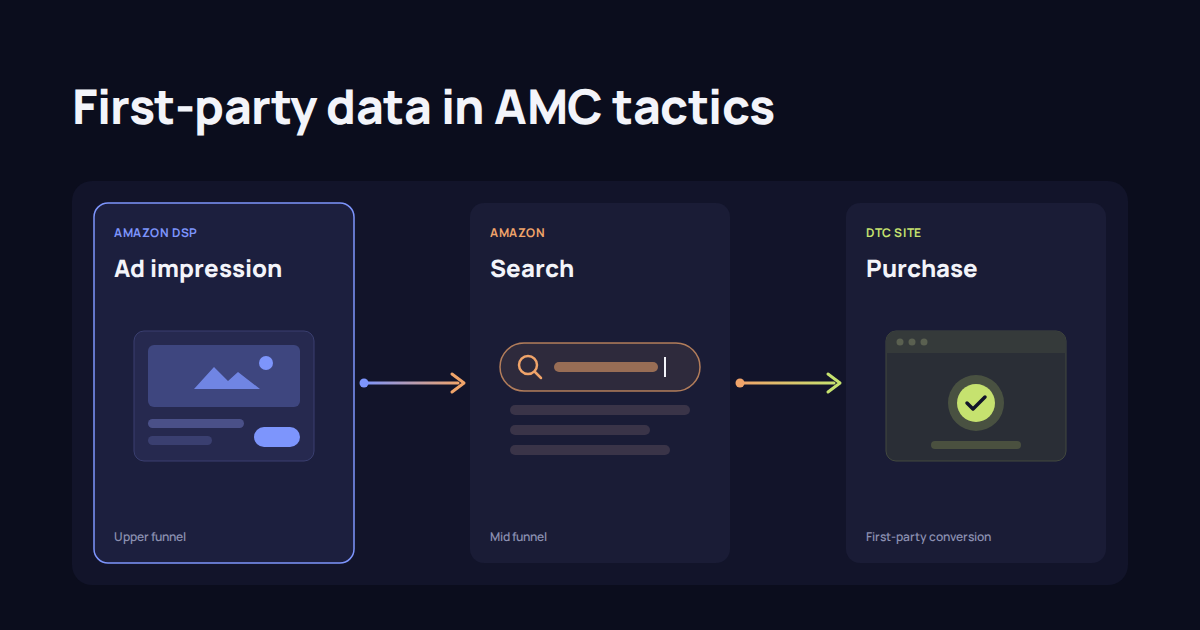
It’s crunch time in the commerce business. Q4 is when advertising costs tick up—but when the right tactics can drive exponential returns.
Thankfully, you’re sitting on a trove of first-party data that can help you make all of that advertising more efficient this quarter.
To back up for a second: when we say “first-party data,” we’re basically referring to any kind of shopper information—emails, home addresses, and so on—that you’re able to tie to a specific shopper event.
You might get first-party data from:
- Point-of-sale in physical retailers
- DTC website visitors and purchasers
- CRM audience segments
By tying your first-party data to Amazon advertising exposures and shopper behaviors, you can make your marketing far more efficient in Q4.
With your first-party data uploaded to Amazon, you can, for instance:
- Track the long-term benefits of Amazon ads on other channels
- Exclude from your Amazon ads shoppers who already buy from you on other channels
- Target shopper audiences with new granularity.
How does first-party data work on Amazon?
When you upload your first-party data to Amazon Marketing Cloud, you can—anonymously—match the shoppers you’re already tracking in your CRM to behaviors they’ve taken on Amazon.
Enhance all of the queries and audiences you already use in AMC—LTV, NTB, repeat purchase rate, CAC, subscribers, and more—with this layer of first-party data.
You also don’t need to worry about compromising your privacy and security protocols. Your first-party data will be hashed when you upload it to AMC, so Amazon can’t see it: none of this information will go back to them.
You can also get a lot more out of this data if you maintain your own segmentation logic when you upload.
FWIW, Intentwise Explore, our AMC solution, makes it easy to upload first-party data. We help you tag every data point with your own custom metadata, hash it for Amazon, and then build queries and audiences off of it.
How first-party data can help you in Q4
Once you’ve uploaded your first-party data, here’s how you should use it this quarter.
Study the behavior of shoppers who are already in your CRM. You may have already built out a sophisticated set of audience segments in your CRM, based on shoppers who have subscribed to your email, visited your site, and so on.
AMC lets you layer on the Amazon behavior of these shoppers. Get a more sophisticated look at how the audiences in your CRM interact with your brand on Amazon, and build AMC audiences to either target them—or exclude them—in your future ad campaigns.
Add DTC and in-person data to cohort matrices. We work with a lot of brands that create cohort matrices to track shopper behavior over 12-month spans.
These brands bundle their customers into groups based on who they are or what they bought, and then track how their behavior diverges over time.
Intermingling first-party data lets you start these cohorts earlier, and end them later. Some shoppers might have bought from you in-store before buying from you on Amazon, or might switch to buying from your DTC after a string of purchases on Amazon.
Measure cross-channel NTB and LTV. With your first-party data layered into your Amazon data, you’ll be able to see the impact of your BFCM deals more fully.
How many of these shoppers are really new, versus how many previously bought from your DTC site or physical storefront?
And how much long-term revenue are these shoppers really generating? Because uploading your first-party data lets you track shoppers across more of your channels, you’ll be able to see the full, cross-channel revenue that your new shoppers generate.
One practical use case of this is to assess the effectiveness of BFCM and other end-of-year promotions is to measure the LTV of deal vs. non-deal shoppers.
Are the shoppers you’re converting actually generating long-term revenue for you, or are they dropping off after making one purchase?
Being able to connect your DTC purchases means you’ll analyze LTV with a wider, multi-channel scope.
Subscription types. Plenty of CPG brands offer subscriptions on their DTC sites and through Amazon’s Subscribe & Save program.
Uploading 1P data to AMC helps you track the overlap between these programs. Are your Subscribe & Save ads for Amazon just cannibalizing your existing DTC subscribers?
Are you seeing shopper migrations where shoppers who buy from you on Amazon end up subscribing on your website?
Any question you have about the relationship between your Amazon subscription program and DTC subscription program, you can start to answer with DTC data.
Exclude, exclude, exclude. By now, you’ve probably noticed that there are a lot of really sophisticated things you can do with first-party data. And really, your imagination is your limit.
But if you want a simple takeaway: what is always going to be useful with first-party data is audience exclusions.
Chances are you’re not going to want to let first-party shoppers—people who buy from your DTC site or purchase your product in physical stores—drift too far into Amazon.
When you’re running Amazon ads promoting shoppers to buy from you during BFCM, or to Subscribe & Save to your brand, you’ll want to exclude first-party shoppers who already buy from you.
This is where a lot of the basic efficiency can come in. If you have a robust DTC or physical store operation, and you want to be sure it stays separate from your Amazon marketing strategy, exclusions are the way to go.
Retarget shoppers from other channels. Of course, you could also go in the other direction. Maybe you want to reach, through Amazon, people who’ve bought your product in a physical store.
After uploading your first-party data, you can easily create an audience of shoppers who’ve bought from you in a store, on your DTC site, or on some other channel for which you have data, and then send them ads encouraging them to buy from you on Amazon.