
Combining Amazon Marketing Cloud query data for AI workflows



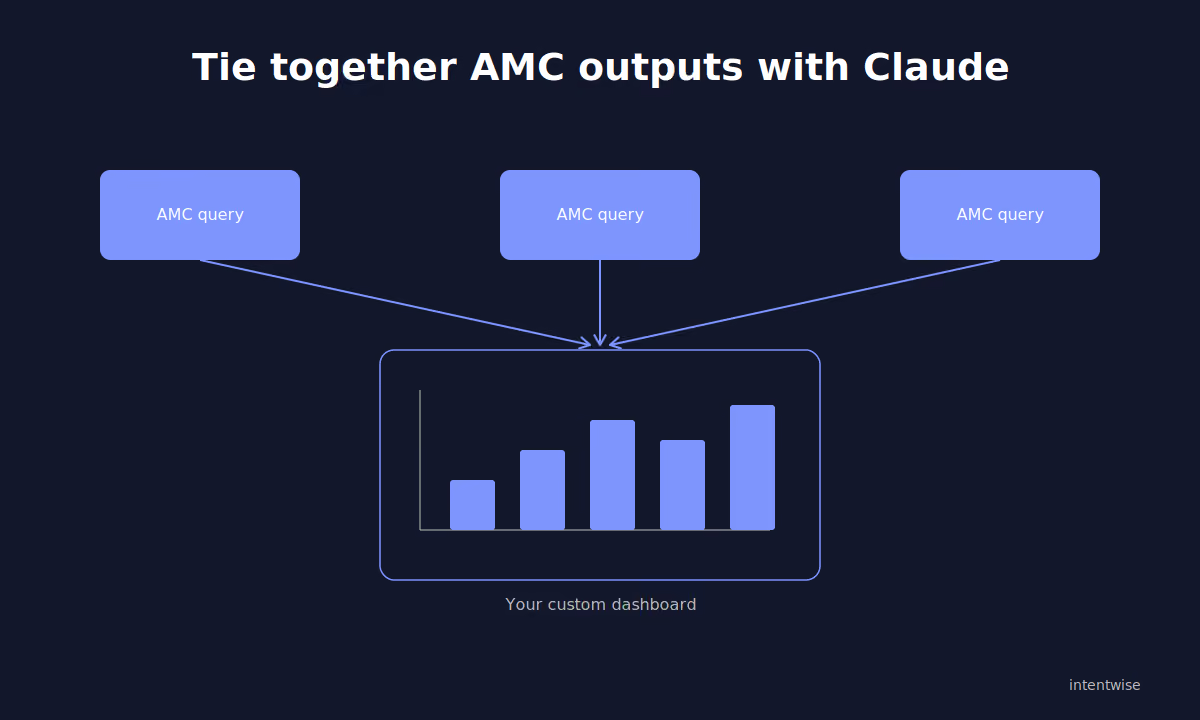
A little-noticed benefit of bringing your Amazon Marketing Cloud data into your AI agent is the ability to combine multiple AMC query outputs.
As you know, AMC provides deep shopper intelligence about New-To-Brand rates, shopper LTV, paths to conversion, ad attribution models, and so much more.
But many brands and agencies still struggle to turn these insights into targeted actions.
Part of the reason is that, when deciding whether to take a certain action, you have to weigh so many insights against each other.
A product’s LTV is a useful data point, but you can’t do much with it if you don’t also have a comparable view of your CAC and NTB rate for that product.
With Claude, you can combine and connect that rich AMC data more easily than ever.
Join together multiple outputs from AMC queries, or layer the AMC-derived shopper intelligence into other data sets you already use every day.
Maybe you want to see a list of your products with the highest New-To-Brand rates alongside your Search Query Performance data, for instance.
With Claude, you can join together any data set you like, and see how they overlap in minutes.
How do you bring AMC data into your AI agent?
First thing’s first: All of these use cases are of course only possible with a MCP connection between your Amazon Marketing Cloud data and your AI agent.
Intentwise’s AI Gateway MCP brings the outputs of your AMC queries into your AI agent, letting you ask questions or build decks using all of the AMC data you’ve gathered from Intentwise Explore.
Plus, we connect all of your other key Amazon, TikTok, Walmart, Shopify, Google, and Meta data sets, so you can easily combine that AMC data with other signals on Amazon and across channels.
Try AI Gateway for yourself today.
What can you do with connected AMC data?
Once you have a MCP that connects your AMC data to Claude, you might tell Claude to build:
A fuller picture of cost efficiency: Rather than just guessing at how cost-effective your marketing strategy is, you can easily join together your SKU-level customer acquisition cost data with your SKU-level life-time value.
This gives you a complete picture of how much your marketing is really paying off—and how much you should be willing to spend to convert a new shopper.
If you want to get even more granular, you could group these CAC to LTV data sets alongside data from AMC’s 5-year lookback data.
Did the CAC to LTV ratio shift depending on the time of year your shopper purchased?
How does the ratio compare for deal vs. non-deal shoppers, or holiday vs. non-holiday shoppers?
Really, anything is possible with combined AMC data sets.
A comparison of different attribution models: By now we all know that Amazon’s default last-touch attribution model makes it hard to assess the success of ads further up in the funnel.
AMC lets you switch attribution models, so you can see how your measures of ad success shift when you assign equal credit to every ad in a purchase journey—or if you give the first ad in the journey full credit for the sale.
With Claude, you can compare and contrast all of these attribution models together.
Build a dashboard of your campaign metrics broken down by first-touch, last-touch, or linear-touch attribution.
Or ask Claude to rank campaigns based on how the different attribution models impact your view of performance.
Which of your DSP campaigns see the biggest ACOS improvement when you switch from last-touch to linear-touch attribution?
Claude can quickly procure a list of those campaigns, so you can quickly see where your attribution model is undercounting (or over-counting) performance.
A combined view of path to conversion and ad overlap data: A similar tactic is to combine your path to conversion and ad overlap reports to quickly isolate the ads that provide the biggest sales lift regardless of your attribution model.
Path to conversion queries show you all of the touchpoints that shoppers have with you before they purchase.
If you layer in ad overlap reports, which measure which ad pairings drive the most sales, you’ll be able to really quickly isolate the most successful ad campaigns across your entire funnel.
Tell Claude to build a dashboard showing these two query outputs together. Or, if you prefer, just ask Claude for a list: which of my ad campaigns drive the most sales list per path to conversion and ad overlap data?
It’s never been easier to figure out which of your ad campaigns really work—and which really don’t.