
Walmart MCP: Unlock deeper analytics with AI and cross-channel data



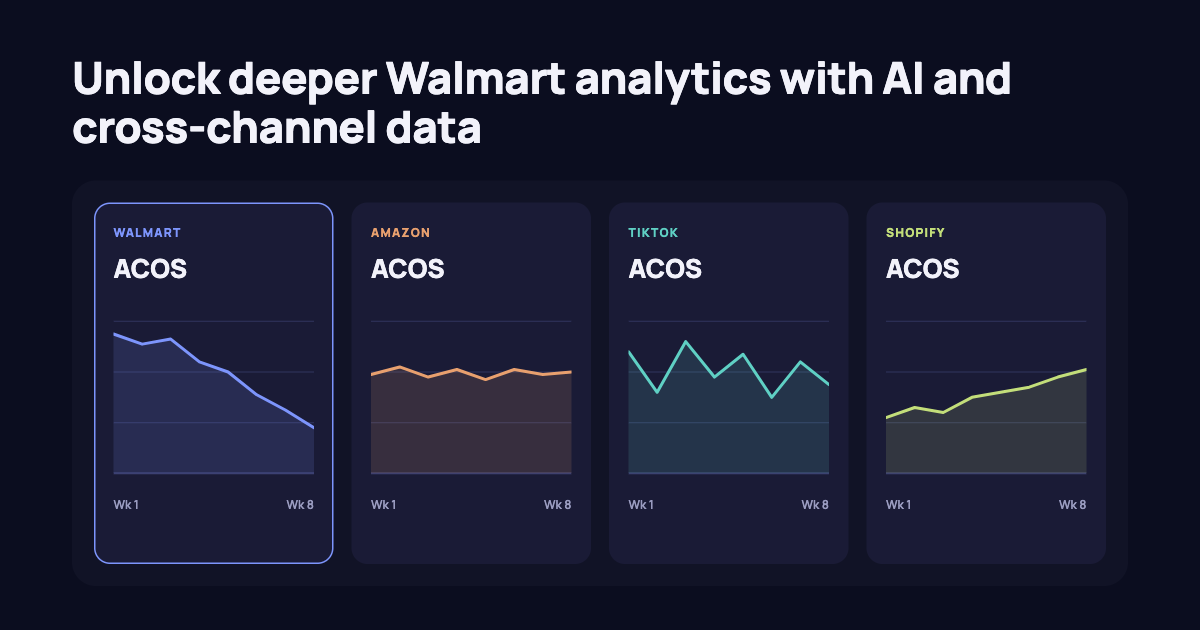
One of the most exciting parts of the AI revolution is that it doesn’t just help you improve your ad performance on a single channel. It also makes it easier to connect the signals across all of your channels, and harness the insights that Walmart, TikTok, Shopify, and Amazon are telling you.
Don’t settle for siloed channel-level data. Backed by a data foundation like Intentwise’s, which is designed to find connections across channels, you can take your analytics on Walmart a lot further—including by using the insights you’ve gathered on other channels to inform your Walmart strategy.
Here are some new-age analytics you can unlock on Walmart with AI and channel-level data.
Using AI to improve Walmart ad efficiency
With your Walmart data connected to your AI agent, especially through a sophisticated MCP like Intentwise’s AI Gateway MCP, deep—and, more importantly, trusted—analytics is only a prompt away.
Ask what changed across your Walmart account. Let’s say you log in and realize your Walmart revenue has dipped for a certain product.
Ask your AI agent what happened, and it can return a number of evidence-based guesses about the biggest drivers of the swing within seconds.
From here, you can diagnose which actions to take next.
Find low-inventory advertised SKUs. A great way to improve spend efficiency on Walmart is to ensure you are never advertising on products that are running out of stock.
This isn’t always an easy thing to spot in the Walmart console—but, with a MCP that stitches together fragmented data sets, your AI agent can ensure you never throw money at a low-inventory ASIN again.
Ask your AI agent for a list of your advertised ASINs with less than 7 days of cover.
You could even set up an alert for whenever an advertised product drops below 7 days of cover.
Evaluate in-store purchase rates. We all know that digital ads drive some number of in-store sales, but connecting the two isn’t always easy. To tie Amazon ads to in-store sales, for instance, you need to use first-party data uploads in Amazon Marketing Cloud.
One great thing about Walmart is that makes it easy to connect your online and offline channels. The platform reports your in-store sales as well as your digital sales, plus it ties physical store purchases back to your Walmart Connect and Walmart DSP ads.
This easy connectivity means Walmart is one of the best places to link in-store sales to your digital marketing.
Ask your AI agent which products are seeing the biggest increase in-stores, which ad campaigns drive the most in-store sales, or which have the biggest offline vs. online gap—products that drive disproportionately more sales on one channel vs. the other.
Identify SKUs with the biggest change in New-To-Brand rate. Walmart offers brands deep shopper data, like New-To-Brand rate, on both the ads and product level (though the NTB data only tracks people who were ad-exposed.) This kind of data is great to trend over time, to audit what’s working.
Your AI agent, of course, makes this easy.
Ask your agent to show you which products have seen the biggest drop or increase in NTB rate over the last 6 months.
You might want to reshuffle your strategy accordingly: the products with an increasing NTB rate might be worth advertising more heavily during Q4 and other major sales events, while the products with decreasing NTB rates probably demand a deeper audit from your end about what is changing.
Using cross-channel data to improve Walmart performance
These next two analytics ideas are all about triangulating ad efficiency across channels.
Chances are, keywords that work really well on one channel are going to be quite effective on the other. It’s also true vice versa: if you’ve discovered that a set of keywords is actually killing your ACOS, you want to be sure you block those keywords on all of your channels.
Of course tracking all of these keywords or product targets across channels is not easy—especially when your channel-level performance lives in siloes. Intentwise is designed to bring all of these data points back together.
Identify high-performing keywords from Amazon not being used on Walmart. A keyword that’s working really well on Amazon, TikTok, or any of your other channels is probably ripe for harvesting on Walmart, too.
Ask your AI agent for a list of high-performing keywords—or product targets, or any other tactic—from your other channels, and then cross-reference which ones are not currently part of your Walmart spend.
These are easy missed opportunities to fix.
Identify low-performing keywords on Amazon, TikTok, and other channels to exclude from Walmart. If you use a platform like Intentwise, which supports negative keyword targeting, you can stop your Walmart Connect ads from showing up on certain low-performing keywords.
Ask your AI agent for a list of keywords on your other channels that are proving to be a drag on your budget, and be sure to exclude them from all of your Walmart campaigns.