
Your MCP can take ads actions. But it needs these 3 traits.



With the arrival of AI and sophisticated MCPs, you can now take advertising actions in the same place where you conduct analytics.
Your AI client no longer just tells you what changed in your account or what to do next—it actually receives your requests for actions, and makes bid or keyword adjustments for you within the scope of your retail media platform.
Through your AI client, you can now change bids, add new keyword targets, and much more in the same chat window where you’re asking questions about your data.
This collapsing of the analytics and execution layers is something that brands have fantasized about achieving for a while.
It is a major unlock in terms of advertising efficiencies and time savings. But brands should be careful about which MCPs they use to take actions, and how they use them.
Just being able to take an action from your MCP isn’t enough. You want to be sure yours comes with the right safeguards to ensure the actions you take are targeted and that you have ample opportunity to undo any actions that aren’t exactly right.
(BTW—we’ve already discussed the key traits you need to look for in a generic retail media MCP.)
Not all MCPs are built the same
Right now, only a tiny number of MCPs allow you to take direct advertising actions on Amazon and other retail media platforms.
This is exciting, because it means analytics, insights, and execution are coming together into one surface.
Let’s quickly run through how this works. You notice that your ad spend has increased, and you want to know which of your campaigns have upped their spend. So you ask Claude for a list of campaigns with the biggest increases in spend in the last 14 days.
Claude spits out a list of campaigns with a big increase in spend.
Now, instead of needing to log into your ads accounts and manually make changes, you can directly tell Claude to decrease the bids on those top 5 keywords by 10 percent.
This is exciting—but we know that a lot of brands are rightfully skeptical about giving their AI agent the capability of making advertising actions.
It’s good to be cautious. You don’t want to grant your agent permission to take actions in your account without a firm backstop, and without ensuring they have the proper context to really know what they’re doing.
The 3 traits a MCP must have to trust it with ads actions
AI generally works great, but it can be fickle. Before you take advertising actions, you need a MCP that is designed to protect you from small errors.
You should look for:
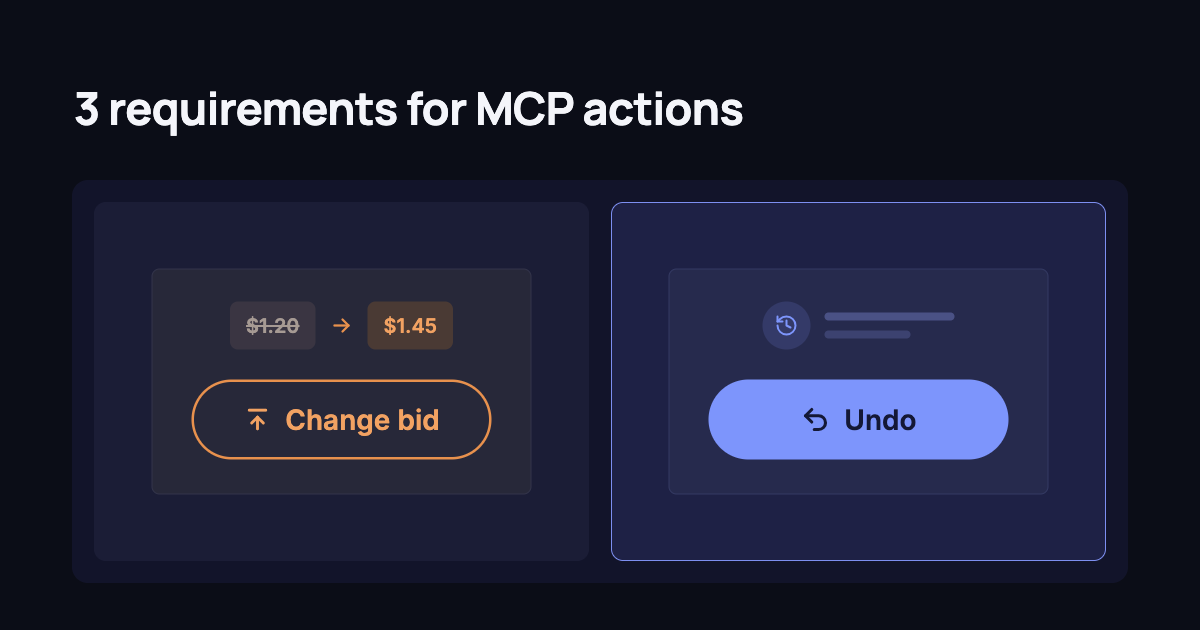
1. A rollback layer. No matter what, you want to be able to undo any actions that you don’t like.
If something goes haywire, or if an agent’s actions end up different from what you envisioned, you want to be able to restore your account to the place it was before.
A rollback later is essentially an “undo” button when it comes to MCP actions. Tell your AI client you want to take the action back, and your MCP will be able to return your account to its original state.
2. Pre-action confirmations. Don’t allow your AI client to take an action without your direct confirmation.
Your MCP should require that your agent explicitly lays out the change it’s going to make before it ever takes an action, so you can be sure nothing got lost in translation.
Your AI agent should tell you some version of, “I haven’t changed anything yet” and here is the change they want to enact. You should know exactly what Claude should do on your behalf.
3. Knowledge layer. In order to ensure your AI client takes smart actions, you want to be sure it is analyzing your accounts with expert sophistication.
Connecting your commerce data to Claude alone won’t do that for you. You need to have a MCP that embeds domain knowledge, a connected data foundation, and a query engine that turns your natural-language prompts into technical requests.
Intentwise’s AI Gateway MCP stands out because we don’t just connect your data, speed up AI analytics, and facilitate actions.
Our MCP comes with a knowledge layer, and we allow you to embed unique domain knowledge, like the product costs that you use to calculate profitability. So you can ask Claude questions about your profitability, and it’ll know what you mean.
We also connect data from multiple of your channels—not just Amazon, but also TikTok, Walmart, Shopify, and more—so you can see the full picture of your commerce accounts from your AI client.