Sales events like Prime Day happen quickly—which is why you want your ad campaigns to reach shoppers who purchase just as fast.
In other words, you want impulse shoppers.
And to find them, you need to look at Time to Conversion data.
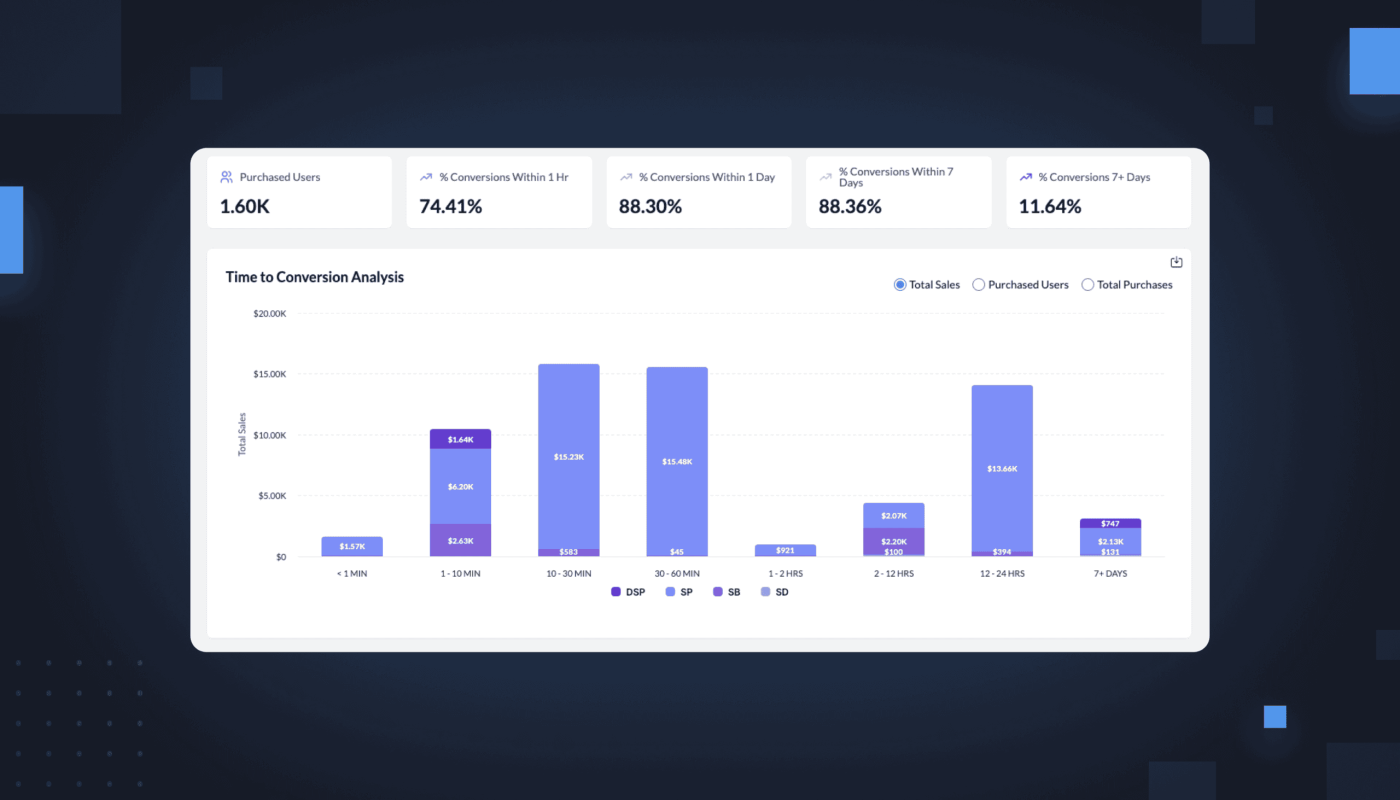
Time to Conversion is a data set within Amazon Marketing Cloud that you can measure either on the shopper level or the ASIN level.
Some of your products will have a Time to Conversion—basically, a consideration-to-purchase window—that clusters around 12 hours. Others, especially higher-price products, might see consideration windows of closer to a week.
Similarly, different shoppers have different consideration periods, too.
Through Time to Conversion data, you’re able to separate out the slow-moving shoppers, who might take a week or more to make purchase decisions, from the impulse shoppers who buy within a day or so.
It’s these impulse buyers that you really want to reach on Prime Day.
What are Time to Conversion metrics on Amazon?
Time to Conversion is a way of tracking the typical shopper’s consideration phase.
It essentially measures the time gap between when a shopper sees your ad and when they actually make their purchase.
A Time to Conversion of 1 week, for instance, means the shopper bought your product 7 days after seeing an ad for it.
For what it’s worth, Intentwise Intelligence users can see their Time to Conversion data, fully broken down by ASIN, when they use AMC. All of these insights stay right at your fingertips.
How does Time to Conversion help on Prime Day?
Time to Conversion data is often overlooked—and, especially during a fast-paced sales event like Prime Day, it shouldn’t be.
Prime Day moves quickly. You want to be sure you do, too.
Run ads toward impulse buyers. One of the best use cases for Time to Conversion data is to identify impulse purchasers.
Within AMC, create an audience of shoppers who converted from you within 1-2 days of purchase. Then, use the lookalike audiences feature to reach shoppers who share similar traits with that initial audience.
With your lookalike audience of fast-converting shoppers in place, you now have a group of impulse buyers to advertise to on Prime Day.
Adjust your ad creatives accordingly. If you run SBV or SPV ads, Time to Conversion can even give you a sense of how long those videos should be.
For instance: If your shoppers tend to buy quickly, or if you’re specifically targeting impulse buyers, then you want to be sure your ad creatives are punchy and to the point.
What else can you do with Time to Conversion data?
Time to Conversion can make your re-targeting operation more efficient.
On one hand, Time to Conversion tells you the best time to re-target a shopper who engaged with your product but didn’t purchase.
If a lot of shoppers buy your product even 5 days after an ad impression, then maybe you want to wait a week before re-targeting them with fresh ads.
But if most shoppers buy within the day, you want to re-target quickly.
If you’re using Amazon Ads to promote a product or an event that is timely—like Prime Day—Time to Conversion also helps you see when to begin your campaigns.
Movie studios, for instance, use Amazon’s Time to Conversion data to ensure they start their ad campaigns at the right time, to drive ticket sales.
What about the time between purchases?
Having a handle on how your sales happen over time is important for repeat purchases, too.
Here you don’t need to consider Time to Conversion, which measures the time from an ad view to purchase, but rather time between purchases.
Time between purchases data tells you how frequently each of your ASINs is repurchased, so you can have a rough sense of when to re-engage a shopper down the line.
If you know your typical repurchase timeline for a certain ASIN is 3 months, that tells you to plan your re-targeting accordingly.
One easy tactic: You can create in AMC a refreshable audience of shoppers who purchased after 3 months, and push them to your DSP or Sponsored Ads campaigns or both.
Download our whitepaper on 5-year-lookback data in AMC to find out how to track these repurchase windows.